
Home / Healthcare

Publications

CFIIM publishes on two parallel tracks. The academic track targets peer-reviewed journals and builds the scholarlyfoundation. The practitioner track translates findings into governance tools and frameworks that allocators, fundsponsors, and advisory boards can use immediately.

Practitioner Track · Playbook Series
1 Published · 3+ In Development
Academic Track · Peer-Reviewed Journals
3 submitted · 12 Pipeline
light grey number 1 in roman numerals
Track One

Practitioner
Publications

Founding survey data (n=50, January 2026) is described as exploratory in design and scope. Frameworks grounded in this data are interpretive rather than definitively proven. Sample limitations are documented in every publication that relies on these data.

gold dash icon
Playbook No. 1 — Governance Architecture · Published
gold dash icon
Playbook No. 2 — Disclosure Standards · In Development
gold dash icon
Playbook No. 3 — Capital Formation Sequencing · Planned
gold dash icon
Playbook No. 4 — Due Diligence Frameworks · Planned
light grey number 2 in roman numerals
Track Two

Academic
Publications

Concepts introduced by CFIIM — commitment latency, the GETA sequence, the Six Frictions Framework — are clearly identified as constructs derived from data synthesis, not established empirical laws. Each is offered for testing, not asserted as proven.
gold dash icon
Why Capital Hesitates — Financial Analysts Journal · Submitted
gold dash icon
Rational Hesitation — IMEFM (SSCI) · Submitted
gold dash icon
Closing the Specialty Care Gap — JAPA · Submitted
gold dash icon
12 further articles · Research pipeline
Featured Publication · Now Available
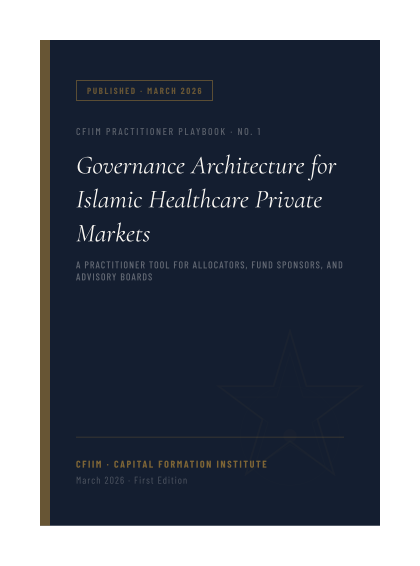
Dark blue governance report book cover design

A practitioner playbook designed for investment committees, advisory boards, and real-world deployment.

Part I
The Commitment Latency Problem
Part II
The Islamic Finance Labelling gap
Part III
The GETA Capital Formation Sequence
Part IV
Governance and clinical guardrails
n=50
Founding practitioner survey, January 2026
78%
Labelling without governance increases hesitation
88%
Documented process associated with strong confidence
Playbook Series · The Full Pipeline
Available Now
Playbook No. 1

Download Playbook No. 1

The founding governance manual. Covers commitment latency, six frictions, GETA sequence, capital stack design, and full appendix of working documents.

Translates · Branch I Diagnosis + III Design
Playbook No. 2

Coming Soon

Title and scope to be confirmed. This playbook is part of the active research programme and will be announced when development begins.

Translates · Branch II Validation
Playbook No. 3

Coming Soon

Title and scope to be confirmed. This playbook is part of the active research programme and will be announced when development begins.

Translates · Branch III · Article 7
Playbook No. 4

Coming Soon

Title and scope to be confirmed. This playbook is part of the active research programme and will be announced when development begins.

Translates · Branch II Validation
Playbook No. 5

Coming Soon

Title and scope to be confirmed. This playbook is part of the active research programme and will be announced when development begins.

Translates · Branch IV · Article 13
Playbook No. 6

Beyond Healthcare: Governance for Islamic Private Markets Broadly

The capstone practitioner series — translating the programme's field-level synthesis into governance frameworks applicable to Islamic PE in technology, infrastructure, and financial services.

Translates · Branch V · Article 15
Academic Track · Peer-Reviewed Publications
Practitioner Insights
CFIIM Research · 2026
Examines why Shariah compliance alone is becoming insufficient as AI compresses screening costs, and introduces maqasid-based positive alignment as the next layer of institutional value in Islamic capital markets.
CFIIM Commentary · 2026
Governance Frameworks
CFIIM Research · 2026
Introduces a twelve-domain weighted scoring architecture that makes governance quality in Islamic financial institutions externally observable, comparable, and decision-useful. Applied across five institutions in four jurisdictions.
Working Paper · April 2026
Playbook · Published
CFIIM Research · 2026
The founding practitioner tool grounded in the active research programme. Covers commitment latency, the Six Frictions Framework, the GETA capital formation sequence, four-layer capital stack design, ethical guardrails, structured due diligence, and implementation pathways. Appendices include working documents designed to be used directly in investment committees, advisory boards, and LP conversations.
CFIIM · Capital Formation Institute in Islamic Markets · First Edition, March 2026
Submitted
CFIIM Research · 2026
Proposes an integrated four-layer capital stack for MENA healthcare infrastructure: Waqf (concessional quasi-equity), Sukuk (senior debt), physician-led private equity (operating layer), and DFI co-investment (de-risking). Establishes physician-led general partnership as a structural governance requirement rather than a branding decision. The first applied healthcare capital architecture for the governance thesis.
JAPA Academy Journal · Jordanian-American Physicians Association · Submitted 2026
Submitted
CFIIM Research · 2026
Demonstrates empirically that Shariah labelling without documented governance process is associated with increased hesitation rather than reduced hesitation — a finding that inverts the standard Islamic finance capital formation assumption. Introduces the GETA sequence (Governance → Education → Trust → Allocation) as the capital formation pathway consistent with the data.
International Journal of Islamic and Middle Eastern Finance and Management · SSCI-Indexed · Submitted 2026
Submitted
CFIIM Research · 2026
Introduces commitment latency as a measurable structural behaviour in private market allocation — distinct from rejection, risk aversion, and pricing disagreement. Identifies six structural frictions inhibiting investor confidence from an exploratory practitioner survey (n=50), with governance credibility as the leading constraint. The paper establishes the diagnostic foundation for CFIIM's research programme.
Financial Analysts Journal · CFA Institute · Submitted 2026
Submitted
CFIIM Research · 2026
Proposes an integrated four-layer capital stack for MENA healthcare infrastructure: Waqf (concessional quasi-equity), Sukuk (senior debt), physician-led private equity (operating layer), and DFI co-investment (de-risking). Establishes physician-led general partnership as a structural governance requirement rather than a branding decision. The first applied healthcare capital architecture for the governance thesis.
JAPA Academy Journal · Jordanian-American Physicians Association · Submitted 2026
Submitted
CFIIM Research · 2026
Demonstrates empirically that Shariah labelling without documented governance process is associated with increased hesitation rather than reduced hesitation — a finding that inverts the standard Islamic finance capital formation assumption. Introduces the GETA sequence (Governance → Education → Trust → Allocation) as the capital formation pathway consistent with the data.
International Journal of Islamic and Middle Eastern Finance and Management · SSCI-Indexed · Submitted 2026
Submitted
CFIIM Research · 2026
Introduces commitment latency as a measurable structural behaviour in private market allocation — distinct from rejection, risk aversion, and pricing disagreement. Identifies six structural frictions inhibiting investor confidence from an exploratory practitioner survey (n=50), with governance credibility as the leading constraint. The paper establishes the diagnostic foundation for CFIIM's research programme.
Financial Analysts Journal · CFA Institute · Submitted 2026
Playbook · Published
CFIIM Research · 2026
The founding practitioner tool grounded in the active research programme. Covers commitment latency, the Six Frictions Framework, the GETA capital formation sequence, four-layer capital stack design, ethical guardrails, structured due diligence, and implementation pathways. Appendices include working documents designed to be used directly in investment committees, advisory boards, and LP conversations.
CFIIM · Capital Formation Institute in Islamic Markets · First Edition, March 2026
Practitioner Insights
CFIIM Research · 2026
Examines why Shariah compliance alone is becoming insufficient as AI compresses screening costs, and introduces maqasid-based positive alignment as the next layer of institutional value in Islamic capital markets.
CFIIM Commentary · 2026
Practitioner Insights
CFIIM Research · 2026
Examines why Shariah compliance alone is becoming insufficient as AI compresses screening costs, and introduces maqasid-based positive alignment as the next layer of institutional value in Islamic capital markets.
CFIIM Commentary · 2026
Working Papers

CFIIM will release working papers prior to peer-review submission where research findings have immediate practitioner relevance. Register below to be notified when pre-prints are released.

How to Cite

Referencing CFIIM publications.

CFIIM publications are intended for use by practitioners, academics, and institutional decision-makers. All outputs are published openly and may be cited freely with appropriate attribution. For papers currently under peer review, please cite the CFIIM working paper version until the final published version is available.

Playbook Citation · APA Format

Capital Formation Institute in Islamic Markets . (2026).  Governance Architecture for Islamic Healthcare Private Markets: CFIIM Practitioner Playbook No. 1. CFIIM.

Playbook Citation · APA Format

CFIIM Research.  (2026).  [Paper title]. CFIIM Working Paper. Capital Formation Institute in Islamic Markets.

For citation of peer-reviewed articles upon publication, please use the journal's standard citation format. DOI links will be added to this page upon publication acceptance.